Browse by topic
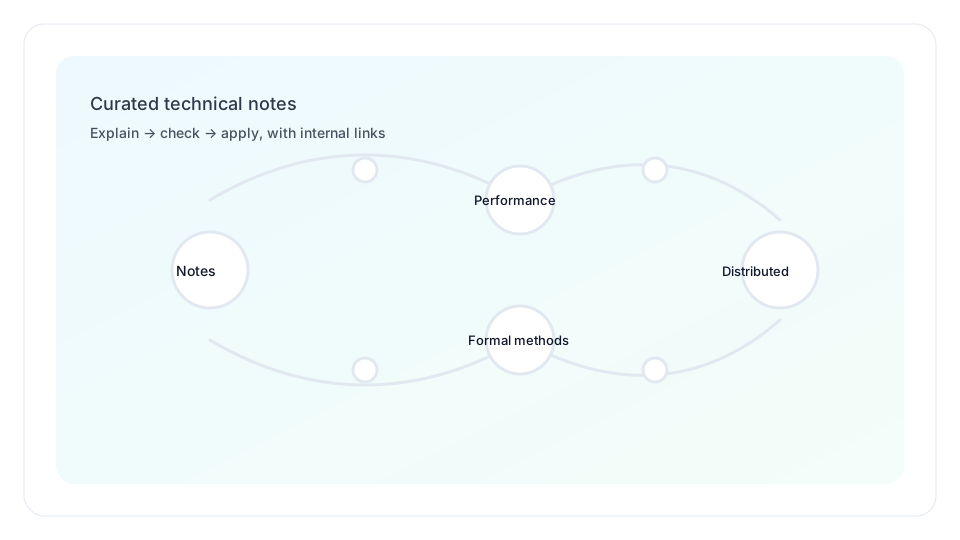
Three topic hubs; each one defines the area, offers a start path, and lists the notes.
Performance
Latency, caching layers, queueing, and diagnosing regressions in web/services.
View notes
Formal methods
Specifications, invariants, model checking, and protocols as tools for clarity.
View notes
Distributed systems
Time/order, retries, idempotency, consensus, and observability for reliability.
View notes
Start here (reading paths)
Three short reading paths, one per topic.
Performance
- TTFB and origin latencyUnderstand request phases and what “first byte” really contains.
- Queueing basics and latency budgetsWhy tail latency explodes and how to set budgets that survive load.
- Performance regressions checklistA workflow to confirm, isolate, and mitigate regressions.
Formal methods
- Specs, invariants, and contractsWrite constraints you can review, test, and monitor.
- Model checking primerExplore behaviour spaces and interpret counterexamples.
- Session types and protocolsMake interaction structure explicit and checkable.
Distributed systems
- Time, clocks, and orderingDefine “before” without relying on a single clock.
- Failure modes, retries, idempotencyDesign operations so retry behaviour is safe and predictable.
- Observability for distributed systemsDebug with evidence across service boundaries.
Latest notes
Six recent notes across all topics.
- Observability for Microservices: Unified Metrics, Traces and Logs in the Age of AIHow to build a unified observability stack for microservices that integrates metrics, distributed traces, and structured logs, including AI-assisted analysis patterns. performance
- Reducing Latency in Serverless and Microservice Environments: New Caching and Queueing StrategiesPractical strategies for reducing tail latency in serverless and microservice architectures, covering cold start mitigation, caching patterns, and queue-based load levelling. performance
- End-to-End Observability: A Must-Have for Multi-Cloud and Hybrid ArchitecturesHow to build observability that spans cloud providers and on-premises infrastructure, covering trace propagation, metric aggregation, and the organisational challenges of unified visibility. performance
- Scaling Formal Methods: Techniques for Integrating Verification into Industrial WorkflowsPractical approaches to integrating formal methods into real engineering workflows: lightweight specifications, incremental verification, and tool integration patterns. formal
- Reliable AI Requires Deterministic Foundations: Ensuring Data Quality and Context for LLMsWhy reliable AI system output depends on deterministic data pipelines, context management, and quality assurance, not just model capability. formal
- Formal Methods for Multi-Agent Protocols: Specifying and Verifying Communication PatternsHow to apply session types, process algebras, and model checking to specify and verify the communication protocols that multi-agent AI systems depend on. formal
- Observability for distributed systemsHow traces and correlation IDs turn incidents into evidence. distributed
- Performance regressions checklistA repeatable workflow for confirming and localising regressions. performance
- Specs, invariants, and contractsWhat to write down so behaviour stays reviewable. formal
- Failure modes, retries, and idempotencyWhy retries create duplicates and how to make outcomes safe. distributed
- Cache hierarchy: edge to originReason about caches as a system, not a single knob. performance
- Behavioural equivalence in plain EnglishWhat “same behaviour” means depends on your observations. formal
How notes are written
- Quick summaryA short statement of what the note covers and why it matters.
- Key ideasDefinitions and mini examples to build working intuition.
- Common pitfallsThe mistakes that recur in practice (measurement, assumptions, and semantics).
- Related notesInternal links that keep the knowledge base navigable and crawlable.